
|
Rather than decide not to vote during an election because you don’t like any of the options, I offer you an alternative: vote more often. Let me explain. A lot happens before a candidate’s name is put on a ballot in a general election. People like you and me can influence how candidates are picked by getting involved with political parties. (Note: I’m Canadian and this post is targeted at Albertans.) While independent candidates do run, it is incredibly rare for an independent to get elected. For better or for worse, Canadians resoundingly choose their representatives based on their political parties, and political parties have their own internal processes for choosing their candidates. I am most familiar with the process used by the United Conservative Party (UCP) in Alberta, so let’s start there. UCP members living in a constituency vote in a “nomination race” to select their candidate for that constituency in the general election. The candidate must be Albertan but does not need to live in the riding, although all the people voting must live in that riding. To be a UCP member with voting privileges, a person must claim to agree with the party’s Statement of Principles and pay a $10 membership fee at least 21 days before the vote. There are some exceptions, but overwhelmingly party members choose the candidates that will be running for the UCP in a general election. The New Democratic Party (NDP) in Alberta has recently begun to have more contested nomination elections to decide their candidates, although historically there have been more appointments. Appointing candidates can help ensure a desired level of diversity among the overall pool of candidates. Appointments can ensure that certain groups such as women, Indigenous peoples, or LGBTQAI2S+ are represented. To be a member of the NDP, a person cannot also be a member or supporter of another political party, whereas the UCP does not have this rule. Furthermore, a membership in the NDP includes both the provincial NDP and the federal NDP. Some Alberta NDP leadership candidates have recently suggested this should change. But currently, in Alberta, you would have to choose which of the two main parties you would like to influence from within, not both. In ridings that predictably elect a particular political party (“safe” ridings for that party), the nomination for that party is typically more hotly contested than the general election itself. Statistically each vote cast in a nomination race carries more weight than a vote cast in a general election, because significantly fewer people participate. As a result, nomination campaigns take on a different flavour than general election campaigns. To be successful, a candidate typically needs to sign up new party members and then distinguish themselves against other candidates that have more in common with them than someone running for an entirely different party. In some cases, they may even be friends who previously worked or volunteered together. While in a general election almost no one pays attention to the individual person and instead just votes according to party lines, at the nomination stage, the individual matters. Some party members choose their candidates at the nomination stage based on a single issue, such as whether the candidate is pro-life or their stance on Covid vaccinations. Other people vote for the person that shook their hand. Others might decide after attending a local forum, where members will also make their own opinions and requests known, which can help to shape the candidates’ positions on issues at an early stage. If a candidate commits to something at this stage to help them win a nomination, it is more difficult to change course for a general election. The point is that getting involved in party nominations can help steer general elections on a different path. Self-described “moderates” or “centrists” in Alberta tend to avoid identifying themselves as supporters of either the UCP or the NDP, and they will not buy a membership for either, because of how “extreme” they perceive both parties to be. But it becomes a self-fulfilling prophecy. It’s precisely because moderates refrain from participating in politics more deeply that their own views or the kind of candidates they want to send to the Legislature are not well-represented in the main parties. By opting out, moderates leave the door wide open for people with strongly-held political or ideological views to call the shots. Such people are frequently active in the political process. I have spoken to people under the impression that by opting out they signal their own discontent, but signal to whom? The other people also opting out? No one is going to agree with every policy in a platform or with every decision a politician makes. But people also don’t agree with every single view held by their spouse or friend, and that does not mean they cannot associate with them. So, I wonder why more people won’t associate with a political party in order to help that party stay or get on track to be something they’d ultimately like to see in government. Political party members influence not only the local candidates but also the party leader. I have personally witnessed people walk away from their membership or involvement in the UCP because they do not like its leader, when ironically it is the members who have the most power to change the leader. Consider that Premier Jason Kenney resigned in 2022 before his term was up because of pressure from UCP members, not because of the general public. I do think there becomes a point when it is best for an individual to disassociate and resign from a board or leave an organization, not just within the political realm but in society generally, whether it’s a for-profit company, non-profit, or religious institution. What bothers me is when resigning or leaving is a person’s first and immediate course of action, before they make it known that they have a concern or disagreement, and when they haven’t made any effort to learn if there is an appetite to make the changes that would allow them to stay. I’ve encountered people on boards who think their job is purely to support and be a team player, and these people tend to be the ones that immediately walk away if they have an issue with someone in leadership, without realizing they have some power to hold the leader accountable. I have also encountered the opposite: people on boards who think their sole purpose for being there is accountability, and they challenge most decisions without being productive or helpful. Neither is helpful; I wish more people realized that there is a balance to be struck between support and accountability in voluntary organizations like a political party. Involvement at earlier stages in the political process can result in better governance for your community, province, and country. However, if at the end of the day, you still dislike all the candidates in a general election, there is something else you can do that is arguably better than opting out entirely and not voting. In Alberta, you can formally “decline” a ballot, meaning you turn out to vote but do not select any of the candidates. To return a ballot, you hand it back to the election offer that issued it to you, informing them you wish to decline to vote. The officer will write “declined” on the back of the ballot and place it in a separate envelope. Declined ballots are reported separately from “rejected ballots.” When noting the number of rejected ballots, it’s unknown how many were because people who wanted to vote didn’t know how to properly fill out the ballot and how many were intentionally spoiled. I scrutineered votes being counted, and I saw some cases where a person would mark an ‘X’ next to all candidates but one – making it unclear whether they liked all the candidates that they marked with an X, or whether they were saying “none of these ones” and supported the one candidate they didn’t assign an X. I also saw ballots that simply had the F-word written on them or words like “Anarchy!” They were all counted as spoiled. Below is a screenshot of election results in Alberta. As you can see, in 2015, a relatively significant number of people formally declined their ballots, and I think this is a better indication of the public sentiment at the time than if all those ballots had been lumped in with the rejected ballots. 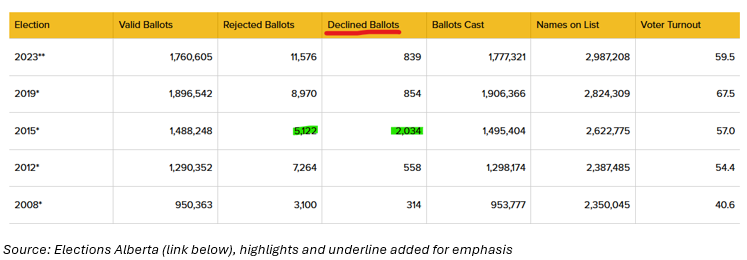 Currently, there is not an option to decline a ballot in federal elections. My understanding is that a few other provinces also allow a citizen to decline a ballot, but not all.
In summary, you can make your voice heard on political issues in other ways beyond voting on Election Day, especially by voting in a nomination contest prior to a general election. Sources used, and for further reading: Dave Cournoyer’s blog, particularly “What I learned tracking election candidate nominations in Alberta” https://daveberta.substack.com/p/what-i-learned-tracking-election United Conservatives Governance Manual (as of November 3, 2023) https://www.unitedconservative.ca/wp-content/uploads/Nov2023-Governance-Manual.pdf UCP Candidate Selection Rules and Procedures https://static.unitedconservative.ca/Candidate-Selection-Rules.pdf Constitution of the Alberta New Democrat Party https://www.albertandp.ca/sites/default/files/alberta_ndp_constitution_0.pdf Elections Alberta: Historical Results https://www.elections.ab.ca/elections/election-results/historical-results/ Elections Alberta: How to Vote In Person https://www.elections.ab.ca/voters/how-to-vote/voting-in-person/
2 Comments
9/10/2024 12:07:01 pm
Great points! I would argue that there's 2 types though: the ones that are moderate, taking views from Left & Right, and then there's the ones who are disappointed because the people they vote in turn their back on their supporters and implement 'wrong' policies. 9/10/2024 12:13:05 pm
My point (which I forgot to make above), is that getting involved earlier, and staying involved on boards can help ensure the 'right' candidates get elected, and then continue to implement policies they ran on. Your comment will be posted after it is approved.
Leave a Reply. |

AuthorBrianna Morris - None of the personal musings here should be construed as the positions of any of my employers or associates - past, present, or future. Archives
April 2025
Categories
All
|
 RSS Feed
Site powered by Weebly. Managed by Hawk Host