
|
Have you ever wondered how the boundaries are decided for an electoral division? Or why the boundaries change at any given street? And who or what decides that? When Canada was established in 1867, the first electoral divisions were built into Canada’s Constitution. Section 51 of the Constitution required a review of the allocation of seats in the House of Commons every ten years, at which time the federal government would describe the new boundaries in a piece of legislation and pass it like it would a normal law. It’s likely no surprise to you that the governments in power at the time would be accused of maximizing their chance of winning elections when deciding how to draw the new boundaries. The term “gerrymandering” refers to the manipulation of electoral boundaries in one’s favour. When I was touring the Massachusetts State House in Boston in 2018, I encountered a portrait of Elbridge Gerry, former Governor of Massachusetts, and learned where the term originated. His riding (another word for “electoral division” or “constituency”) was changed to a shape comparable to that of a salamander, hardly an intuitive shape for an electoral division, but one piece in a larger reapportioning plan designed to help the Republican Party. “Gerrymander” is thus a portmanteau of Gerry + salamander. Gerry apparently lost his own seat despite the odd shape, but his political party still succeeded, and he went on to become the 5th Vice-President of the United States. For a modern example, let’s say a rural constituency consistently votes for one political party, whereas people in the heart of the city consistently vote for an opposing political party. A suburban riding in between contains a mixed bag of voters that have elected different political parties in the recent past (aka a “swing riding”). When it comes time to redraw the boundaries, each party would likely want some of the area where they have strong support added to the suburban area to tip the vote in their favour. Theoretically, gerrymanderers could get even more specific or strategic than this when redrawing boundaries in Canada. While any given voter’s ballot is anonymous, people may not realize that voting results are reported not only for a full riding but at a granular level. If you’ve watched coverage of election results, you may recall phrases like “12 of 23 polls reporting” as vote counts come in. Voters are typically assigned a specific poll, and each tabulates votes separately. For example, in the riding of Sherwood Park in the 2023 provincial election, more citizens who voted at Woodbridge Farms School voted NDP than UCP, while more people who cast votes at Bev Facey Community School chose UCP over NDP. So, having a particular neighbourhood or street within a riding can help or hinder someone seeking to get elected, and there are ways to help predict which way an adjusted riding will vote. In 1964, the federal government in Canada passed the Electoral Boundaries Readjustment Act, which set up commissions to readjust electoral boundaries, taking the direct responsibility away from sitting politicians. It was an effort to thwart, or at least reduce, gerrymandering. Similarly, in the province of Alberta, the process is governed by the Electoral Boundaries Commission Act. The last commission in Alberta was established in 2016, and it contained five members who received written submissions and held public hearings across the province. The next commission in Alberta may be established as soon as this year. Population is a major factor taken into consideration when determining electoral boundaries. In Alberta, each electoral division is to be within 25% of the provincial average population for a division, with up to four allowed to be more than 25% below the average population. My personal view is that rural ridings should have a lower population than the average urban riding to keep their geographic size at least somewhat reasonable. Consider that a riding like Rimbey-Rocky Mountain House-Sundre (population 44,860) has the three named towns in addition to Eckville and Bentley, and rural counties such as Mountain View County and Clearwater County, all with their own mayor and councils, as well as the Big Horn, Sunchild and O’Chiese First Nations, also with their own leadership. Assuming the riding has a good MLA who puts in an effort to be meaningfully involved and present in the community, attending high school graduations and meeting constituents face-to-face to discuss concerns, that MLA will necessarily have a more difficult time juggling their schedule and getting to important events in their riding than an MLA in an urban riding. For example, the riding of Calgary-Fish Creek has a slightly bigger population of 45,560, but it appears that all of its residents are represented by one municipal councillor (ward 14) and the mayor of Calgary, meaning its MLA has much less engagement to do with the municipal level of government. I am willing to bet that in most cases, issues will vary more from town to town in Alberta than from neighbourhood to neighbourhood within Calgary or Edmonton. Consider that in 2015, the town of Hanna lost 200 full-time, well-paying jobs due to the provincial government suddenly accelerating the phase-out of coal. This was about 7.5 percent of Hanna’s population. If it were in Edmonton, proportionally this would mean losing 62,000 jobs, and in Calgary, around 90,000 (the approximate population of two ridings). Yet, instead of having two MLAs to work on this significant issue (and it would actually be more, because in Calgary and Edmonton it is common for a resident’s house and workplace to be in different ridings), it was the one MLA for Drumheller-Stettler (population: 40,065) who had a truly meaningful stake in the issue, and the MLA was also representing the larger towns of Drumheller and Stettler. (Check out a podcast episode where my colleague and I interview Mark Nikota from Hanna, and we talk a bit about what’s happened since the coal phase-out.) Now, one can possibly make the case that within an urban riding there is still an equal number of stakeholders with different issues given the population size, but an urban MLA can still more efficiently schedule meetings with all those stakeholders. According to Google Maps, driving from the far northeast tip of the Calgary-Fish Creek riding (Diamond Cove) to the far southwest tip of the riding (Sundown Way) takes 13 minutes. Contrast this with a rural riding like Peace River in northern Alberta (population: 41,385), which contains the towns of Peace River, High Level, and Rainbow Lake. Google Maps indicates it takes 4 hours and 20 minutes to drive between Peace River and Rainbow Lake, never mind how difficult it would be to travel to even more remote locations in the riding. I am not asserting that any particular MLA works harder than another. Some MLAs representing urban ridings no doubt work harder than some MLAs representing rural ridings, as it’s largely up to each MLA how much effort they put into their job and what they prioritize. I am positing that if an MLA wants to meaningfully represent their constituency, in almost all cases, representing a geographically large riding requires more traveling, stakeholder engagement, and issue juggling than it does in a geographically small riding. Therefore, geographically large ridings should have a lower population to somewhat level the playing field. There are people who disagree with me. As noted in the latest report of the Electoral Boundary Commission for Alberta: [People] advocated that the Commission should not permit any negative variances for rural constituencies because that would improperly prioritize rural areas. [People] proposed that the Commission consider growth trends and suggested that projected areas of growth support a reduction in the number of constituencies outside of Edmonton and Calgary. While rural MLAs typically get more funding than urban counterparts to enable satellite offices, and the advent of the Internet and video calling has aided communication, in my opinion, there is still no replacement for the real presence and attention of the actual MLA. While it’s true that urban populations are growing and rural populations are decreasing, city folk should be wary of what the demise of small towns and family-run farms could mean for them and our economy. The cities need rural Alberta to succeed, only one reason being that rural Alberta grows much of our food. Despite rural Albertans paying the same rate of income tax as urban Albertans, rural Albertans already experience much more limited access to important services like healthcare, which is where close to half of all provincial expenditures go. Losing doctors and schools in rural areas only exacerbates the issue of more people choosing to leave and move to cities. In summary, I think it is profoundly misguided to reduce the representation of rural Alberta in the Legislature. If you’re an Albertan, I encourage you to pay attention to when the next Electoral Boundaries Commission is appointed, see what’s being proposed, and consider making your own submission. Sources used: https://www.ourcommons.ca/procedure/procedure-and-practice-3/ch_04_2-e.html https://laws-lois.justice.gc.ca/eng/const/page-2.html#h-7 https://officialresults.elections.ab.ca/orResultsED.cfm?ED=81&EventId=101 https://www.elections.ab.ca/resources/reports/electoral-boundaries-commission/ https://www.elections.ab.ca/uploads/abebc_2017_rpt_final.pdf https://globalnews.ca/news/3176500/were-going-to-lose-200-full-time-well-paying-jobs-what-the-coal-phase-out-means-for-hanna-alta/ https://blogs.loc.gov/law/2017/02/elbridge-gerry-and-the-monstrous-gerrymander/ (including photo below) 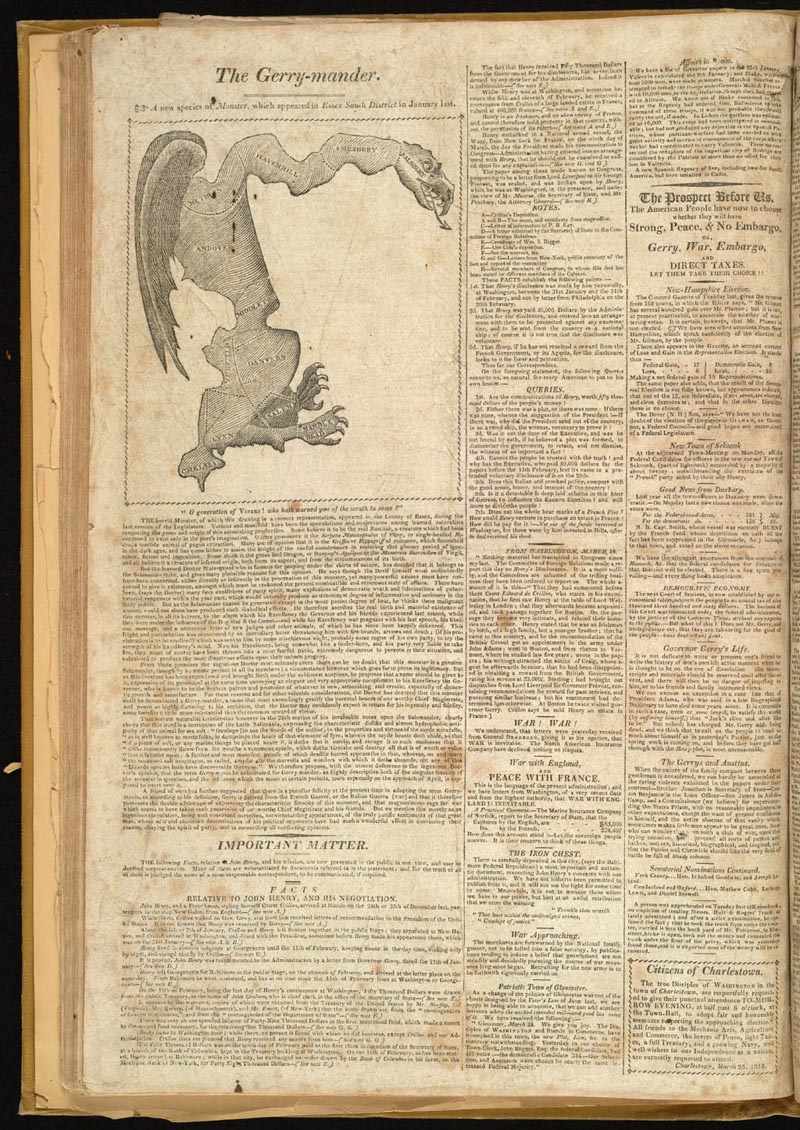
1 Comment
Hello! Thanks for checking out my little website. My hope for this blog is that it is an outlet to discuss public policy issues and share some personal observations. I used to pontificate or publish long posts on my personal Facebook page, which often led to spicy debates in the comments sections, friends unfriending me, and other friends asking for me to make the visibility public so they could share it with their own networks. When I made a post on the healthcare system public, it was shared in a Facebook group of activists where people were encouraged to "give [me] hell". I admittedly was a bit amused at one of the comments in that group stating "The worst thing about her post is its eminently reasonable tone." (Thanks, I try!)
I made a deliberate decision a few years ago to cease making such posts on the spur of the moment, in an effort to question some of my own biases and spend more time thinking and observing. I once again feel comfortable putting my ideas and observations out there, and a blog is less transitory than a social media post. A few random things about me: -I can recite pi to 40 digits. This is an irrational accomplishment with almost no end purpose other than it can be used as a fun fact. -I have my Class 6 (motorcycle) licence. -My first job was at Dairy Queen. I worked there loyally for 5 years and still enjoy DQ ice cream and cheeseburgers. -I've been teased by colleagues for being someone who will actually look up sources to see if it says what a person says it does. (spoiler alert: it often doesn't) |

AuthorBrianna Morris - None of the personal musings here should be construed as the positions of any of my employers or associates - past, present, or future. Archives
April 2025
Categories
All
|
 RSS Feed
Site powered by Weebly. Managed by Hawk Host